Why is it so hard?
When I am writing a piece of fiction, one of the things I find most difficult is drafting in the subtext. A character wants something, they ask for it. A character thinks something, they show or say it. I have always thought this problem lies with my straight-forward view and approach to life which could be described as me being ‘as subtle as a house-brick’.
I have managed to bumble through and add subtext in revisions, but not always – and not always very successfully. It is one of the areas of my writing I feel is weakest. And so, with my house-brick mentality, I have, of course, tried to tackle it head on.
What I learned, I really want to share – in case there are other writers out there doubting their own skills.
1. Subtext is normally added in revisions and redrafts.
WOW. Mind. Blown.
The major doubt I had with my writing of dialogue and character-action is that I couldn’t master subtext in the first draft (I call the first draft the vomit-draft, because I hate it so much it makes me want to hurl).
What does this mean? Well, it means I have permission NOT to do subtext until I’m revising a section of text. If I do think of some subtext signallers to add in the vomit draft, well then, I will. But otherwise, I’ll not think about it until revising which will free up some of the very limited brain power I have for other things – like what I should be thinking about.
2. The Bane of Backstory
Subtext is meant to be snappy, and to capture readers in a web of questions they want to know the answer to. Mixing dialogue with subtext with sections of backstory cause the subtext to be less effective.
Imagine the opening scene from Pulp Fiction:
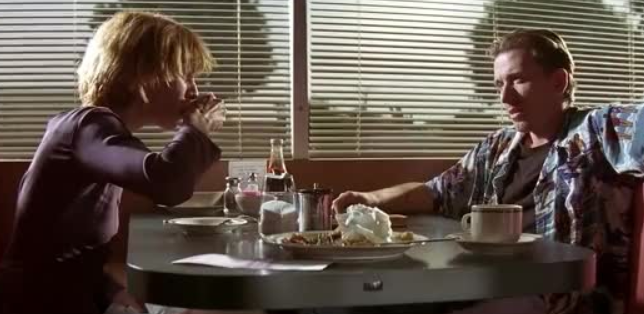
“No, it’s too risky,” he said.
Imagine then, we add in backstory, the spell of that initial line of dialogue is lost – the questions about the character are answered. The reader knows everything the writer thinks important.
Dull.
My take away from this? Trust my readers to ask those questions and to investigate the story more – and don’t feel compelled to answer every question every time questions arise.
3. What isn’t Said.
What isn’t said is exactly what Subtext is. In the Woody Allen film, Annie Hall, the following conversation takes place. The subtext is in italics.
HER: Hi! (Oh, God, nobody cool says Hi.)
HIM: Hello! (I’d love to take her out. I hope my deodorant’s working.)
HER: Nice view. (He’s talking to me! And he’ll hate my silly dress.)
HIM: (Taking a furtive step toward her) Just look at the clouds over there. (I’ve got to find out who she is.)
HER: I’m Leslie … (What a stupid name. He’ll hate it and hate me.)
HIM: Neat dress. (I just love her name.)
What isn’t said can be acted. In fiction, in writing, this means using character action in small ways to help clue the readers in to the subtext. It also helps break up walls of boring back and forth discussion that would otherwise be uninteresting. We’re talking facial movements, what people do with their hands, or who they look at when they talk.
4. An Unanswered Question
In a series of questions and answers between two characters, we can insert subtext by removing either one of the the other. A character can answer with physical responses, creating a layer of mystery about what they think or mean. Or a character can answer a question that wasn’t asked.
Using some of my own characters as examples:
Pryad watched as Sarhu returned, frowning. The younger boy glanced his way and back to the floor again, head hanging.
“I can’t find her either,” he said.
In Conclusion
I used to beat myself up about not having much subtext in my vomit draft. But in my research, I have found that subtext is best added after, layering the mystery and fine-tuning the story so that it is the most engaging it can be. I have uncovered a few simple ways to make sure that there is subtext within my writing too and where it should be dispersed to avoid limiting its impact.
If you have any tips for adding subtext into writing, please let me know! I’d really love to see them.
In researching this article, I looked at the following sources: Diane Callahan – Writing Subtext in Dialogue, The Art Of Story – Dialogue Part 1: Text, Subtext & Context, Lisa Hall Williams – Beyond Basics for Writers
 Imagine Erratically