World building is one of the essential skills of a fantasy writer. And yet, it can often cause so many problems: from issues with overwriting the world to inconsistent construction to terrible tropes in world building.
I pulled five videos from various YouTube channels that I have found to be useful in not just understanding what world building is, but how to do it well and what things to avoid. While no one video can give the whole answers for everyone, I feel like these provide a comprehensive starting point to develop your own approaches to world building.
Tale Foundry – How to world build
First, I have chosen two videos from last year which elaborate on how world building is done, and done well. In general, the content on this channel is of a high quality, in particular these vids are very, very informative. Tale Foundry’s guide is much more comprehensive than I have seen online.
Hello Future Me – World Building in Action
The next YouTube video deals with a work of anime, but almost all of the principles work for anime, film or writing. I thought this video helped in reflecting on how I world build,and on the techniques in the Tale Foundry entries above. It is well worth a watch.
Jenna’s Do’s and Don’ts
Jenna Moreci is a prolific YouTuber with a strong following and some solid videos. I tend to find her earlier videos more informative, and these fall into that category. Jenna’s informal style helps her cut to the quick and her guides on these points are perfectly on point.
In conclusion…
This isn’t a comprehensive guide, but after watching these videos, making notes and having a go myself, I found I was able to build believable settings with interesting features and exciting settings. With the ‘Kingdom of the Lion‘ novella I am writing, I used these techniques to help make my world feel more real.
Which guides have you found to help you world build? Share them with me and I’ll maybe be able to update this short guide in the future.
I saw this today and, having just finished the first draft of a children’s horror novella, it did make me smile. I miss every single criterion from this graphic: my hero is very flawed, this journey is less than heroic, my antagonist isn’t ruthless – well, not totally amoral, and I apparently forgot to include Basil – the time travelling archaeologist snake.
And despite all these flaws, I love what I have done so far. I know it is a first draft – my vomit draft, I call it – but I’m pleased with what has come out.
When I am writing a piece of fiction, one of the things I find most difficult is drafting in the subtext. A character wants something, they ask for it. A character thinks something, they show or say it. I have always thought this problem lies with my straight-forward view and approach to life which could be described as me being ‘as subtle as a house-brick’.
I have managed to bumble through and add subtext in revisions, but not always – and not always very successfully. It is one of the areas of my writing I feel is weakest. And so, with my house-brick mentality, I have, of course, tried to tackle it head on.
What I learned, I really want to share – in case there are other writers out there doubting their own skills.
1. Subtext is normally added in revisions and redrafts.
WOW. Mind. Blown.
The major doubt I had with my writing of dialogue and character-action is that I couldn’t master subtext in the first draft (I call the first draft the vomit-draft, because I hate it so much it makes me want to hurl).
What does this mean? Well, it means I have permission NOT to do subtext until I’m revising a section of text. If I do think of some subtext signallers to add in the vomit draft, well then, I will. But otherwise, I’ll not think about it until revising which will free up some of the very limited brain power I have for other things – like what I should be thinking about.
2. The Bane of Backstory
Subtext is meant to be snappy, and to capture readers in a web of questions they want to know the answer to. Mixing dialogue with subtext with sections of backstory cause the subtext to be less effective.
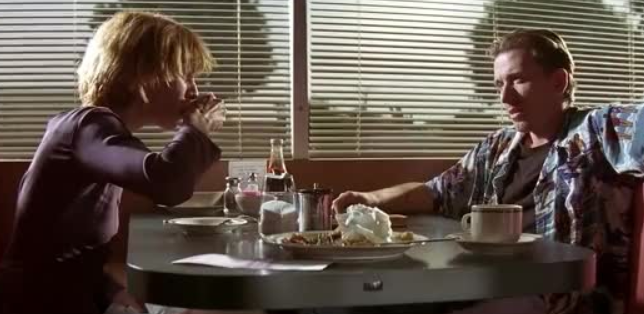
Imagine the opening scene from Pulp Fiction:
“No, it’s too risky,” he said.
Imagine then, we add in backstory, the spell of that initial line of dialogue is lost – the questions about the character are answered. The reader knows everything the writer thinks important.
Dull.
My take away from this? Trust my readers to ask those questions and to investigate the story more – and don’t feel compelled to answer every question every time questions arise.
3. What isn’t Said.
What isn’t said is exactly what Subtext is. In the Woody Allen film, Annie Hall, the following conversation takes place. The subtext is in italics.
HER: Hi! (Oh, God, nobody cool says Hi.)
HIM: Hello! (I’d love to take her out. I hope my deodorant’s working.)
HER: Nice view. (He’s talking to me! And he’ll hate my silly dress.)
HIM: (Taking a furtive step toward her) Just look at the clouds over there. (I’ve got to find out who she is.)
HER: I’m Leslie … (What a stupid name. He’ll hate it and hate me.)
HIM: Neat dress. (I just love her name.)
What isn’t said can be acted. In fiction, in writing, this means using character action in small ways to help clue the readers in to the subtext. It also helps break up walls of boring back and forth discussion that would otherwise be uninteresting. We’re talking facial movements, what people do with their hands, or who they look at when they talk.
4. An Unanswered Question
In a series of questions and answers between two characters, we can insert subtext by removing either one of the the other. A character can answer with physical responses, creating a layer of mystery about what they think or mean. Or a character can answer a question that wasn’t asked.
Using some of my own characters as examples:
Pryad watched as Sarhu returned, frowning.The younger boy glanced his way and back to the floor again, head hanging.
“I can’t find her either,” he said.
In Conclusion
I used to beat myself up about not having much subtext in my vomit draft. But in my research, I have found that subtext is best added after, layering the mystery and fine-tuning the story so that it is the most engaging it can be. I have uncovered a few simple ways to make sure that there is subtext within my writing too and where it should be dispersed to avoid limiting its impact.
If you have any tips for adding subtext into writing, please let me know! I’d really love to see them.
WARNING: The last five mins of this video is an advert for a VPN platform. I skipped them. As I usually do. Apologies if you watch it by mistake!
WARNING 2: Read on – I’m not just linking the video with no consideration or critique!
Are games an art-form with the same credibility as Novels or Movies?
So, I saw this video on Youtube – I’m subscribed to the Closer Look Youtube Channel and they have some very interesting videos on there. What the central question of this video is, is can video-games be art? The Author of the Game of Thrones series, George R. R. Martin, says it isn’t yet – but it will be. The video argues the point that it already is.
This made me think – not in any straight lines with any clear, reasoned arguments to refute or support the idea, but on a personal level. As a child of the 80s and 90s, I have played games all my life. I used to play with a ZX81 that was my father’s, I wrote my own games, learned to code in BASIC before I knew all my times tables. It is fairly safe to say that computers and computer games have been a part of my life for most of my life.
But are they art?
A quick internet search drew this amazing quote which I have shamelessly stolen (and attributed).
So, what is art and what can it do? Art can be fine craft, music, a painting, a sculpture, a building, a performance, a poem, a novel, and many other creations. Art pushes limits. Art broadens minds. Art stimulates conversations. Art can be crafty and art can be high-minded. Art can be all of these things depending on who is considering it. That is why art seems to endure. It is constantly changing, morphing and developing based on current taste, trends, political environments and emotional states of the community and artists who create it.
Because of the amount of art there is out there in the world, there is some that each of us might find uninspiring or even confusing, while there will be some that we find inspirational and resonates with us. At the same time that art is complex, diverse, global, confusing, it is also compelling, interesting, stimulating and beautiful. And this is what makes art, Art.
Andi Bedsworth
Owner of Art To Go, which brings free art opportunities to children in the community.
By this definition, anything can be art. Which maybe explains why sawing a shark in half or painting in ones own poop seems to have critics fawning or ready to murder in High Art circles. Henry, from the Closer Look, is right: Games can be art. But that doesn’t mean all games are.
Which opens an interesting doorway for someone like me. If games have as much credibility as novels and films do in the realm of fantasy stories, does that mean that Skyrim would be something I could mine for interesting ideas? Is Neverwinter Nights II a valuable experience for me as I examine high fantasy settings? Would it hurt or help to play Vampire: The Masquerade – Bloodlines if I was thinking of writing a horror story?
The answer, I think, has always been yes. Many games, I think, fall in the category of genre fiction – they aren’t high concept stories, but they are very fun to play and very interesting. They are also an invaluable source to mine for ideas to adapt, change, and use as inspiration.
Thank you, Henry from the Closer Look – A great video.
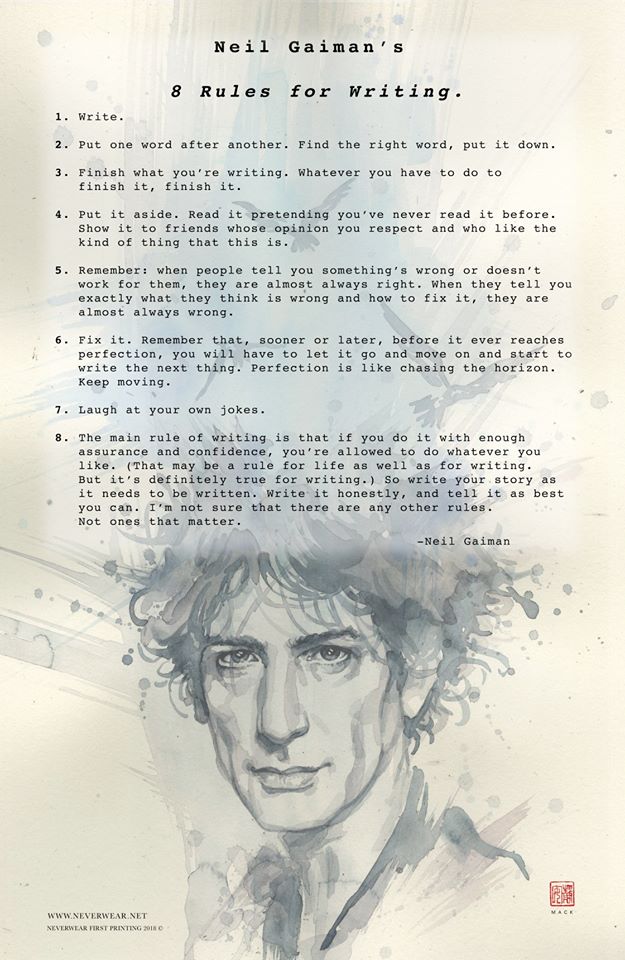
Neil Gaiman is among my favourite authors for his fluid style and his amazing body of work – American Gods, the Graveyard Book and others being personal favourites. I have seen this image doing the rounds on Facebook and on Twitter and thought I’d share what those rules mean for me.
1. Write
Wait… Isn’t the first stage of the writing process procrastination? Doh! Well then, time to turn off Facebook, the TV, crack on some heavy metal backing tracks (no lyrics to sing along to) and actually write. Who knew?
2. Put one word after another…
I’ve not really suffered with Writer’s Block much. As a rule, I generally have more ideas than I can write about. Often, they are god-awful, but sometimes these ideas are pretty cool. It is very similar to having verbal diarrhoea – not so much Writer’s Block as Writer’s Splurge!
3. Finish what I am writing.
Um. Crap. Yes, I hardly ever finish my longer pieces. I have a children’s novella almost complete bar a few thousand words, sitting staring at me. I have a good half of a horror novella that really got me interested in writing, languishing on my hard drive. My files are ghosts, never-born stories of half-finished ideas. Hehe – even the posts on this blog have their share of these spectres – Posts begun and never finished, and waiting for life to be breathed into them as they are completed. Perhaps I have found my new target for writing?
4. Reread old pieces.
This is something I do with the spectres of stories I haven’t finished. Then I end up rewriting sections of them, adding a few thousand more words sometimes… and then leaving them again. Perhaps I have too many ideas, but I don’t think so. I think perhaps, having several pieces on the go at once helps me. I always have something I want to write in one or other of them, at least.
5. Ask for feedback.
Yes! I am a beta reader myself, and always seek criticism of my work. But often the feedback is unhelpful. ‘Very Cinematic’ doesn’t tell me much. ‘This is good’ isn’t helpful. I feel like real criticism is a very in-demand skill.
6. Let things go.
This is a hard one but one I have begun to accept. The point of the blog remains to publish and share my writing with others in the hope of improving my own writing skills. To do that, manuscripts have to be published and often – I have found – I’ve overlooked simple errors in them. Perfection is like chasing the horizon, though. I like that. I have permission to be bad!
7. Laugh at my own jokes.
Family and friends will tell you, I do this all the time. Especially in A&E at 2am trying to make a selfie duckface while suffering from partial facial paralysis and laughing far too loud.
Thank you to Neil Gaiman for those wise words!
If you want to read some of my original fiction, either hit the Library tab at the top of the page, or else begin reading my fantasy novella, Kingdom of the Lion, here.
One of the many Youtube Channels to which I subscribe is Terrible Writing Advice. The videos are always on point, funny and have a charm that I can’t help but like. And the most recent video released is very pertinent to a current project: The Kingdom of the Lion, the tale of Pryad of Sumeria.
The video:
If you are interested in writing, I’d suggest liking, sharing and subscribing to Terrible Writing Advice.
But what impact will this have on Pryad’s story?
Gods and Goddesses
There are established Gods and Mythology from history from the civilisations of Ancient Sumeria, but I’m not an expert on them. I have researched a few to add into the tale.
For example:
To the sneak-thief, it was like he was being dragged through Kur, the realm of the dead, an endless cavern-system where all there was to eat was dust.
When Pryad is being dragged to the garrison of the penal army, I made a simple reference to Kur, the Sumerian underworld, and added a key detail. Could this be important later on, perhaps? Who knows!
Another example:
“But he trained at the Ziggurat -”
“No way he’s spell-wise.” Pryad pulled Sarhu back from the corner of the building. “What’s got into you? Can you do this or not?”
The initial draft of the story contained more references to either magic, ‘lore’, or historical gods and goddesses but I removed them. Why? Simply put, they were not pertinent.
When I write, sometimes I try to be too clever and end up making my story more like a textbook with a narrative in it. Clearly a character flaw, I try to make sure that it doesn’t leak into the finished product. I think these two half-explained details make the world far more interesting than not having them in, and both are needed to explain things that happen afterwards.
Terrible Writinng Advice has hit the nail on the head when they say that lore should be sprinkled across the text. In the Harry Potter (by J K Rowling) series, from the first instalment to the last, the lore is never fully handed over to the reader and they have to work for the secrets they learn. In the Wizard of Earthsea by Ursula le Guin, the readers don’t understand about the antagonist until the final act, and even then not entirley.
What does this mean for my writing? Well, if you were hooping for a info dump in the first few chapters, you are going to be disappointed. While there will be some Lore, I have tried to spread it out so thinly it is hardly noticeable until it is needed.
Although delayed by holidays in the very top of England (or the very bottom of Scotland, depending on how you look at it), here is the final instalment of the first chapter of Kingdom of the Lion. Read about a poor chap, a victim of both circumstance and hopelessness, and the compatriots he is thrown in with as the finishing touches are put to the second chapter.
Chapter two is really easy to unlock – One single comment is all it will take to get the thing posted up here as soon as possible. Let me know what you think so far – Tell me if Pryad is a good character, or the setting is interesting. Anything. Don’t try and tell me about a fantastic money-making scheme you’ve conjured up using Bitcoins and Western Union though.
Honestly, though, just having people read this means I’ve been successful in finding people to read my work. Having a little feedback would be lovely, but it is the icing on the cake.
Sat in a caravan over the holiday, with the rain whipping down, Netflix was my friend. One of the films that piqued my interest was Noah. The film is more than a faithful retelling of the Judo -Christian Bible story or the Mesopotamian legend uncovered on cuneiform tablets by the British Museum. Instead, I take the film as a fantasy adaptation of the story to explore contemporary concerns. The story was written by writers who among them handled Skyfall, I Am Legend, Gladiator, The Last Samurai and Pi. In short, blockbuster stuff.
Though it has a low audience review score on Rotten Tomatoes, it seems critics did not pan it. There are several interesting aspects about the film. And some worrying aspects too. For instance, the film lingers on the idea of a race-war between the line of Seth (who are pure) and the line of Caine (who are all evil, apart from their women apparently). The two sides are likewise portrayed in tones of black and white. The hatred displayed in certain scenes felt uncomfortable but not so much so that I turned off half way through.
In no particular order, some of the aspects I liked were:
The Fallen Angels
The rock monsters, called the Watchers, are angels who sought to help Adam after he was banished from the Garden. As punishment, they were twisted into their boulder-like forms by the Creator. They are presented as having no clear idea to the questions of faith than mankind has. In short, fallible. Thinking about angels in Hollywood Blockbusters, this isn’t always the case (I’m looking at you, Constantine and Dogma!). One of the angels has the best line in the movie.
“You remind me of Adam.”
Mankind Has The Capacity To Undermine The Creator
Methuselah undermines Noah’s choices which he sees as circumventing the mission he has (to rebuild the world without humanity in it). It was a daring choice of the film makers to present God as someone who perhaps can make errors given that there is a strong Christian community in America. However, it puts agency back into the human’s hands and not in some divine beings. From a story-telling perspective, that’s a clever move.
The Last Seed Of Eden
If there was one part of this story I wish I could steal it would be the last seed of Eden. Not a masterful plot point or some excellent dialogue, but a macguffin that means that Noah can build the Arc. Still, it is a very cool macguffin (and one I hope one day to appropriate in some way)
How Will I Use This?
As a side project, I am currently plotting and drafting a story about the ancient Irish legend of Aoife and Aoibh. It would be awesome if I could make the story more than a simple retelling and instead introduce elements that interest me.
What are your thoughts of the film? Has it inspired you in any way? Let me know by adding a comment.
So first, an admission. I picked this book up for a quid in WHSmiths for my holiday and didn’t have high expectations. It was just something to fill the time while I waited to come home to my WiFi. I picked it up because it had a cool blurb and was on clearance.
I am so glad I did.
I opened it up the first night and only put it down when I was three quarters of the way through it. I woke up and picked the book up again. I was as hooked to it as its antagonists were hooked to blood!
Yeah, it’s a vampire book but more action adventure than horror. There is magic, psychics, zombies and vampires. There is even a Van Halsing type character. I enjoyed this a great deal and am keen to hunt down the next installment of the Laura Coxton series.
I’ve picked out five things I really enjoyed about 13 Bullets.
5 – Gay female main character
So it might be a bit ‘woke’ of me but this was a refreshing change. In your classic vampire tale, it’s the woman who gets saved. In 13 Bullets, the main character is more than capable of saving herself, is gay and isn’t represented as sexual promiscuous. Hell, I’m a straight hetero male (ignore the rumours) and I could relate to her. She flipped a lot of the tired old trope on their head.
4 – Van Helsing is a broken man
In all the films and in classic literature, the vampire hunter is presented as being a man of action and solid moral absolutes. No spoilers, but Arkeley is not at all in control despite his best efforts…
3 – Full Throttle Pace
There are no still, quiet moments in 13 Bullets. It is a white-water rapids of a story and you can’t (or I couldn’t) put it down.
2 – The Faceless
Vampires create minions. This is a trope dating back to the first legends of the vampire. The minions in 13 Bullets are called the faceless. They are sitting carcasses that serve their masters mostly out of year. They have little characterisation but we do get snippets to show how they are more victims than monsters. Morality in the book’s universe seems a very grey area.
1 – The Vampires
So cool. The vampires in this story are different enough to make them feel unique. They are more the monsters in the vein of Nosferatu than clones of Dracula. They can make themselves more than a physical match for even a powerful human. Conor McGregor and Floyd Mayweather wouldn’t last a round with these crazies. They feel ‘post-human’ in the story, beyond human. And through the the text, they are compared to crack addicts – needing blood like a junkie needs a fix. To Wellington’s credit though, things are more complicated.
Like a thief in the night…
I am going to steal a few things from David Wellington. Or at least, I am going to try and include them in my writing.
What is done so well in the novel is that common horror tropes are turned on their head: the camel rescues herself, the vampire hunter is more sociopath than the vampires, the undead are far from beautiful. This is no Twilight, no glitter-vamps here. That subversion of expectation wasn’t forced into my face either, rather I only realised it when I tried to assign tropes to what I had read. I would really like to do something like that in my own fantasy work. Could I subvert traditional tropes, much like in Game of Thrones?
Wellington writes with a pace that makes his story hard to put down. Something is always ‘happening’. I try and do the same in my own stories – especially in KINGDOM OF THE LION – so I plan on dissecting portions of the story to help me do that in a more effective way.
Finally, even when it would be easier to hide a plot detail, Wellington instead commits fully. When the Faceless banged on Victim’s window, I knew something was up. But I didn’t know what until almost the last chapter. That is, to me, a well crafted story.
13 Bullets is the first of a series of books. I’m looking forward to reading the next installment.
So it isn’t a book. I know. I have, in my few years upon this Earth figured out the difference between a movie and a book, but having recently watched this film again on Netflix, I really wanted to celebrate some of the things that I think the story and the production achieved well.
I won’t go into how it’s a flawed masterpiece or how it seems dumbed down – My personal feelings are that too many judge this children’s movie as a film for adults and that the studio itself interfered to make the ‘plot’ clear to all (this is actually true! The Skekses weren’t even supposed to use Human language in the original cut). But I will find five amazing things that I loved about this narrative.
5 – Special effects by Jim Henson & George Lucas’ special effect team
While ‘Special Effects’ might be a bit far fetched, the scenes that were painted were done by the same people who did Star Wars and are amazing – some of the best on film prior to CGI. Better even than some of the CGI scenes that would come after. And the locations within the film’s story are all sets, they aren’t ‘on location’ filmed. This gives the setting a feeling of ‘the other’ that Lord of the Rings and The Hobbit both failed to do. While this is pretty important in a visual medium as a writer it isn’t my major worry so I’m relegating this to 5th place.
4 – Aughra
Aughra takes the part of the Mentor an guide from the Hero’s Journey, the theory of the monomyth which Dark Crystal almost perfectly fits. This role is traditionally given to males in all the fantasy and Sci-Fi I can think of on the spur of the moment – Ogion is Ged’s mentor from the Wizard of Earthsea, Brom in Eragon (and then Oromis), Gandalf in the Hobbit, Rothern (and the Akkarin) in Trudi Canavan’s Black Magician Trilogy, e.t.c.
Why does this matter to me? Well, being the father of a daughter who sees me read and who shares and emulates the same value in reading I do, I want her to find relatable characters in whatever fiction media she consumes. Aughra is. She’s everyone’s mad grandmother (my daughter has two of those!) or crazy Aunt (A.V!).
3 – Kira is actually the real hero
When we think of a hero in fantasy fiction, they are rarely passive. Even in the events of Harry Potter, the titular character makes choices and has an impact on the story. In Dark Crystal, Jem is just a vehicle for the audience to understand the central conflict. It is his companion, Kira, who is the real hero. Jem has no skills other than throwing, catching and following orders. Kira can talk to plants, has a sidekick and makes plans to see the prophecy come to fruition. In the end of the film (SPOILER – but I mean, if you haven’t seen it, its your own fault. The film is 38 years old soon) she even makes a heroic sacrifice, paying her own life in return for healing the dark crystal.
2 – Fear
Right from the beginning of the film, the Dark Crystal is scary. It opens up with a shot of the bad guys and then things just get more and more ‘Other’ from there on in. The protagonists don’t even look human, so the whole film has an alien feel that makes it quite disarming to an adult, but chilling as a child. This was the stuff of nightmares, in places. The Garthim, for example, the giant insectoid warriors, remind me to this day of a dense surge of cockroaches I got far to close to once in India.
1 – The Skeksis
I love, love, love the Skeksis. How many tropes form fantasy do they fulfil? An Evil Emperor (two actually), trail by sword, political infighting, commanders of an army of drones, mass-murderers, sucking the life-force from others to imbibe and extend their own lives! They are some of the best bad guys in any film – in any story – that I have found. Their motivations, as bad guys in a children’s fictional working, are uncomplicated: they want to live forever.
So what does this mean for my writing?
Dark Crystal. There won’t be anything like it again. Even with the sequel coming out on Netflix supposedly. It won’t be the same because now storytelling is different – expectations of children’s film and literature are different.
My main take-away from the film is that Henson wanted to treat children like adults, that he respected them enough to make a scenes not immediately understandable when he didn’t give the Skeksis language in the first cut. He trusted them enough to frighten them. In short, he had an understanding of his target audience.
My target audience changes a lot during my writing process. Sometimes I’m writing to impress a Writing Group, or sometimes I’m writing to have something to read to my daughter in years to come. Sometimes I’m writing for friends or family who will never read what I’ve written. But I should be more like Jim Henson.



 Imagine Erratically