Growing in Power

On Writing: Magic Systems and Handling Power Escalation [ Mistborn l Last Airbender l Naruto ]

I won’t spoil this video but I want to compare this with a series of books that I love, and another that is written by the same author. These are the Black Magician Trilogy and the Age of Five, both by the amazing author, Trudi Canavan.

I love both series. I think that they deal with the issues from this video differently though, which is very interesting.

Are the Powers earned?

Sonea is a natural, a wizard who is so powerful, her magical power leaks from her body and forces the Magician’s guild to hunt her and train her. She spends a great deal of the first book not having control of her spells, seeking dubious alliances and finally having to deal with the antagonists of the first act.

In comparison, Auraya Dyer gains almost ultimate power in the first act of the book. True, she has to deal with the kidnap of her family and the entire village in the first chapter, but we don’t have enough time to make the sudden ascension seem earned.

Do they grow in power?

Sonea does grow in power as she moves through the three books in the Black Magician Trilogy. Her power level at the end of book three is many times greater than when she resolves her issues in the end of book 1. This is down to her learning Black Magic, of course, and having to use it to defend her homeland from an invasion.

In the Age of Five, the invasion happens almost right away, but though we think the antagonists are actually the 5 Pentadrian High Priests, or the Wilds, a larger foe behind them is revealed. Auraya Dyer was always going to have been this powerful in the books – all she does s learn new ways of using her power which have greater and greater effects and end up destroying not one entire religion, but two!

Which is better?

The Black Magician Trilogy got a lot of love compared to a slew of less enthusiastic reviews from readers (though they’re all wrong, the series is great!). But the escalation in the former works well. In the latter, the ceiling for the powers is never totally shown – How can one limit a god and leave and feeling all powerful? However, the rules of the magic system are not given in one great lump but are secrets earned in the story that allow the Priestess of the White to grow in ability – she always has the capacity, just not the knowledge to access it.

In the end, these are different stories – one about finding love and losing it, and another about discovering what is true and what is not, and making a choice that impacts the entire world. The magic systems are not the same (I think many people expected them to be – I did when I first read the book, initially). But that’s okay, because both work for their respective stories and demonstrate Canavan’s ability as a great writer.

And the point, my dear man?

The point is that I will endeavour to be like Trudi Canavan (okay, I can try to be an amazing, international bestseller but that’s a little beyond my horizons right now). I will try to make sure that my magic systems fit the kind of story I want to write about. In my current work, the Kingdom of the Lion, I need to make sure the magic system will be clear, the limits as definable and as clear as I can make them because I don’t want power escalation – I want to have antagonists that challenge a character’s basic identity and personality as well as their ability to smush them into a fine paste.

Thanks to Tim Hickson ( https://twitter.com/TimHickson1) for the video and to Trudi Canavan (https://twitter.com/TrudiCanavan)for her awesome works of fiction!

Lets Review: The Hobbit by J.R.R. Tolkien.

The Hobbit – It is the bar against which almost all other children’s fantasy is judged, and much adult fantasy fiction too.  Published in September 1937, it has endured as the most influential novel in the genre coupled with the Lord of the Rings trilogy which came out seventeen years later.  What better book is there to review first and hone my reviewing chops on than this timeless classic?

I haven’t been reading this alone, however.  My day job is working as a Primary School Teacher in the UK.  I’ve been reading this book with a class of nine- and ten-year-olds too – children the same age as I was when I first read this book.  Seeing their responses to the text has informed my own judgements about what it is like and how good it is.

So, first of all, what were my top ten favourite things about the Hobbit?

10  – Thorin’s verbal diarrhoea 

If it can be said in three words, Thorin will stretch it out to a hundred.  He’s such an over-talker, and very formal too most of the time. This is amusing – I have met so many people like that (usually in a professional capacity,I hate to say). It  makes him seem pompous and aloof and flawed. But it also makes him seem likeable for those failings. Nobody likes a king who is too perfect. The trait stamps a personality on one of the dwarves which are lacking early on in the book.

9 – Bert, Tom and William

Such an iconic part of the Hobbit has to do with when the Company of Thorin Oakenshield are caught by the three trolls. Despite their best efforts, they are only saved by Gandalf impersonating the trolls.  This scene is exciting and interesting, and has some fine comedy moments in it (The confusion about the Burrahobbit for example) and the class and I were laughing through the antics of the trolls.

8  – Proper Goblins

For some reason most visual and written fantasy tales told in the last f decades (at least that I am aware of) treat goblins at best as fodder and at worst as comic relief. Reading the Hobbit, it is refreshing to see them treated as skilled, aware and tactical – and utterly vicious and selfish. They are masters of machines, of gunpowder or its Middle Earth equivalent, and are stealthy as hobbits! It seems a pity that these creatures have been reduced to so little in modern role-playing games especially, but there is always the Hobbit to enjoy them in, at their best.

7 – Elrond schools Gandalf

When the Company of Thorin Oakenshield reach Rivendell, they meet Elrond who helps them with the next part of their adventure. He also drovers moon-runes that were not noticed before by Gandalf. Gandalf is put out by this discovery, and though he gets over it fast, is still irked at not being the smartest kid in class. This part is all me – it made me chuckle that one of the demi-god made a mistake and was annoyed by it.

6 – The Power of Birds

The Hobbit is filled with the power of birds.  They really first appear as the Eagles save the company from the Wargs and goblins.  A thrush leads the Dwarves to the hidden gate into the Lonely Mountain, and then relays Bilbo’s discovery of Smaug’s weak spot to Bard (who kills the poor Dragon).  The crows, led by Roac, allowed Thorin to talk with his cousin, Dain, as the Dwarves of the Iron Hills rushed to help the besieged company. Without their help, at the major points of the story, Thorin and company would have failed.  So, in short, the birds in the Hobbit rock. 

5 – Down to Goblintown

The Hobbit is filled with songs – as is most of Tolkien’s Middle Earth work.  But it is Down to Goblintown which gets the ‘Grammy’ for most awesome song. Of course, that’s my personal opinion, but it is also the correct one!

4 – The Last Stand Against the Wargs

Surrounded, with Wargs and Goblins on one side, and a precipice and death on the other, and with fire consuming the trees they are hiding in, the company are about to die.  Gandalf feels it too, which makes the reader sure it is going to happen. The rescue by the Eagles isn’t too much of a Deus Ex Machina, but the moment before it happens is one of the most exciting in the whole story.

3 – An Unexpected Party

The very best chapter in the whole book, from beginning to end, is the very first chapter. Where other chapters have really good scenes, the one that shines the most and the longest is the first chapter.  It begins with a chance meeting with some old fireworks peddler and ends with Bilbo leaving without an handkerchiefs. 

2 – My Precious!

In his misadventures in the Goblin tunnels in the Misty Mountains, Bilbo runs across a little known creature called a Gollum. They riddle in the dark – the stakes being the means to survival (for poor, tasty Bilbo) and death (by being eaten).  I isn’t so much the chapter itself, but the character of Gollum that is timeless. 

1 – The Spiders of Mirkwood

What?  Gollum isn’t the number one?  This has to be some sort of a joke?  Except it isn’t. Gollum is awesome and all, but the Spiders of Mirkwood outshine him, at least in the Hobbit. They can talk, first of all, and they don’t like name calling – which I think is just too awesome. And it is the fight against them that Bilbo suddenly gains a great deal of individual agency. Still, if it wasn’t for Sting and the One Ring, even poor Bilbo would have been powerless.


The Hobbit is a great story.  But it is not perfect (Don’t send me death threats yet). As I said earlier, I was reading this book with a class  of 10-year-olds and in so doing, a few different issues came up.

Archaic English

With language being a fluid, living thing, it is inevitable that the books had become dated.  What doesn’t help is that Tolkien wrote it the novel as a literary rather than genre novel, using complicated and unusual sentence structures even for his age. My class struggled to read the book, especially the latter chapters, where some of the paragraphs were very dry and complicated to read. 

Diversity and Identity

The Hobbit was written by a white man for white boys and as such lacks any major female characters and any characters of diversity. This isn’t a bad thing, a sign of the times that the author lived in.  However, it is hard for some people to see themselves reflected in any of the characters in the story. In addition, some unhealthy stereotypes do exist in the narrative – with poor fat Bombor being fat-shamed more than once. 

Video Adaptation

Those damn awful films – Peter Jackson did a real disservice to the book in his adaptation of the Hobbit.  For various reasons (gone into much more depth in various reviews) the films added too much, changed too much and moved the emphasis of certain parts of the tale and the end result was a mish-mash of recognisable scenes and made-up hogswash (I mean, why would you add Radagast in the Hobbit even after he was left out of Lord of the Rings).  Anyway, I just hope that these films are not the main way that the Hobbit is remembered by following generations.

But the main thing?

The main thing I learned in reading the Hobbit was something I need to remember as a writer: Give the main character AGENCY.  Bilbo has no agency in much of the first half of the book. He can’t resist the dwarves in chapter one. He is caught straight away by the trolls. His only real agency at all comes in riddles in the dark where he has to face Gollum. And in Mirkwood he begins some sort of transition into a pulp hero immune from failure.  The thing is, in my recent reread of the book, I found Bilbo irksome at first because he was so passive. By the time he was fighting spiders I cared about him more. He mattered more when his actions meant something, he was important to the story. The more agency my character has, the more interesting he will be as the plot unfolds. 

In any case, the Hobbit is well worth a read. 

Erratic.

Fran

This short piece came from doing the Open University Creative Writing course (for free). I did this just under a year ago and I’m still happy with it – so onto the Blog it goes. Any tips for me? Let me know!

If you want to try the course for yourself, go to Start Writing Fiction @ the Open University I can personally recommend the course – which is a set of exercises and took me only a few days to complete while I was working. There isn’t anything ‘groundbreaking’ in the course, but it did help me focus on what I needed to know and there are loads of good resources to access.

Enjoy

Erratic


Like the roar of a Boeing 747’s turbines, the students burst into George’s lecture theatre and spilled along the isles.  The suddenness of their appearance startled him – he pressed a hand to his chest to stop his heart cracking his ribs with the surprise.  He hid his {shock} by taking off his glasses and rubbing his eyes with his fist. Then he shuffled his lesson notes. And then he checked the thermostat.

George, Professor G. E. Vagun that is, was remarkable in so few ways except perhaps in how closely he resembled that particular stereotype of an absent-minded lecturer. Bespectacled with black-framed glasses; pencil thin frame enclosed in a lab coat; and with wild hair that looked a bit like a garden left to go wild, he was every bit every drawing of every professor from every comedy sketch on television.  The more cruel of his students, he knew, had taken to calling him ‘Beaker’ after the Muppets character. He ignored the slur when he heard it in his classroom.

Years of experience meant that George knew instinctively when to begin, waiting till almost all of the students had settled down.  He cleared his throat – a habit picked up from his worthless father. When people didn’t react, he cleared it again louder and then looked down at his notes.

“Today, ” he said, “We are going to be-“

Fran’s face seemed to stare back at him as he glanced up from his notes to see the sea of half-interested faces.

Fran.  God, how he missed her voice, the sight of her – from her auburn hair to her chocolate eyes and her too-big (but still beautiful) mouth.  He remembered he had once joked about her freckles being an amazing dot-to-dot problem. He remembered how his persistence and honesty had finally been rewarded when she accepted an invitation to dinner.  Finally in Nice, France, she had said ‘Yes’.  

“Professor?”  The word was loaded with expectation. 

George nodded absently, more to shake the image of her face from his mind.  “Where was I?” he muttered to himself. There was a spurt of suppressed laughter from a small pocket of the students.  George ignored it and continued.

Counting Down the Thunder

I wrote this on the 6th February 2019 at the Wear Valley Writers Workshop in Bishop Auckland, County Durham England. The prompt was a set of odd words of which I chose ‘Bobowler’ which I discovered meant moth. Having not used the word before, I set out a story where one suddenly appears.

Enjoy,

Erratic


The scraping, shushing, sighing Shhh-Shhh-Shhh sounded from somewhere upstairs. With the power out, the darkness swelled and amplified the sound. Angela grasped the arm of the armchair so hard her knuckles cracked as she listened for it again. But there was only silence.

Silence.

Shhh-Shh-Shh. The noise scraped a silhouette of an image in her mind, sweeping horrific forms to the mystery music sometimes playing, sometimes not.

Angela Barnfather was, to not too fine a point on it, too shit-scared to move. The power-cut had rendered redundant all the protections the modern world afforded her from things that went bump in the night. In the dark, science meant nothing – superstition ruled. Now, the black was like a vacuum and sound rushed in to take the place light had vacated, painting a world lit by threat and danger.

Only, the sounds came intermittently. She tried counting, silently, the lengths of quiet and thought at first she might have found a pattern.

“Seventeen,” she had said.

Then, “Twenty.”

Then, “Twenty three.”

But then she’d been surprised with a ‘sixty-two’, and far more alarmed with a ‘Seven’. She felt like a child counting the time between the flash of lightning ad the rumble of thunder.

Angela Barnfather wasn’t easy to scare either – Her role as headteacher to a Primary school where the kids had been raised by hard knocks meant she had seen plenty, faced plenty. Plenty more than she could ever have wanted to. Sh described herself as ineffable. Unflappable. Her staff might have added incapable too, but not within earshot.

Shhh-Shhh-Shhh.

An image of a long, leathery body with scales scratched over the wallpaper of her imagination and made her recoil deeper into her armchair.

“One, two, three, four,” she counted under her breath. “Five, six, seven, eight.”

“Had Tommy Raskin felt this afraid?” she wondered to herself. Had he wanted, with every fibre of his being, to escape the darkness.

Forcefully, she shoved Raskin and his mother from her thoughts. She embraced the new monsters of the night her imagination was birthing. They were far less frightening.

Shhh-Shhh-Shhh.

She gave up trying to count the thunder, though it was quieter than thunder and far more sinister. She chided herself instead.

“Silly old woman, to be scared of noises in the dark,” she said. Her voice was loud in the night and she thought she could hear her own fear in her words. She pretended to herself she didn’t await the creature’s reply. After all, Angela Barnfather liked to think of herself as unfaltering, unflappable.

Silence. Maddening silence. More and more, the quiet stretched out, building like a pressure behind Angela’s eyes. She willed for it to make a sound as hard as she could. If she could hear it, he knew it was near -but not too near. She knew she wasn’t alone. Thomas Raskin had been alone in the end but she deliberately did not think about that, about the distorted isolation. Instead, she stood up.

Her house was laid out in much the same fashion as her office – that is to say there was no organisation at all. Her divorce meant she had no husband to keep, no standards to have imposed on her, or for her to impose on herself for the sake of appearances. She didn’t need to maintain a pretence of order except at work, where the thin skin of her lies manifested as bullying and vindictive lectures to staff, children and parents alike.

Her husband had used to complain about the cupboard under the stairs – he called it the cupboard of doom. Each time he’d opened it, something always fell out and nothing could be found in the clutter. Now, that cupboard had become her whole house. She couldn’t think of him either, though. Angela pushed aside her fond memories for George, and tried to think of something, anything, else.

Shh-Shh-Shh.

An owl with feathers as course as sand and as tall as a bull stretched at the walls. A wolf’s rough fur brushed against the wooden doors. Angela sighed, no longer terrified of her own imagination, just scared.

Stumbling through the minefield of discarded shoes, books, papers, bottles and glasses, Angela fumbled through the hall into the kitchen. She used her fingers to locate the sink, her digits sliding into something sticky and soft. Her brain screamed ‘BRAINS!’ in bold, neon letters. She closed her eyes – something about them being closed helped, despite the fact that it was pitch black in the house. She lifted a finger to her tongue and tasted jam, not the grey matter of some unknown victim.

Opening a kitchen cupboard under the sink loosed a landslide of things inside crashing to the floor. She jumped back, panting, heart hammering in her chest. Secrets, lies, shames – they spilt over the floor to be lost in the darkness.

“Fuck,” she hissed to herself.

Fumbling, she finally found the torch and turned it on. Soft, welcome light filled the room and dispelled her imagined demons.

Shh-Shh-Shh.

The noise was still coming from upstairs.

Barnfather was not fragile or prone to timidity. he described herself as rugged, respectful. The news had called her reckless and reprehensible. Angela picked her way to the staircase and listened, head cocked to one side.

Silence.

Silence.

Silence.

Just like Thomas Raskin had heard. Underground, in the caves as the rain fell. Only the trickling of flood water and the ice cold to keep him company until-

Silence.

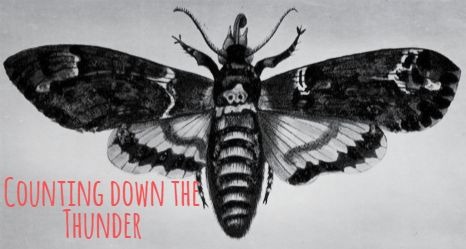
Suddenly, a huge bobowler flapped and flustered into the torch which made Angela scream. The giant moth was limp grey but bloody huge, like Raskin had been when they dragged him out of the caves, tongue protruding, eyes huge and dead. She described it as disgusting., deplorable, despicable. She was well used to these words.

It had been an accident. Accidents happen, she told herself.

She brought the torch down on the moth and crushed it against the wall with so much force the torch smashed in her hand. It broke apart and disintegrated in her hand, leaving her alone in the dark. With only her tears.

And silence.

By The Sword

What follows is one of my early pieces of writing. Originally, the text was a confused mess of past and present tenses, and of clauses that didn’t quite make sense. It was published back when Elfwood.com was still ‘the place’ to be and won a moderator award. I’ve dusted it down and polished it a little, but the story remains largely unchanged.

It was inspired by a couple of things. First and foremost was James Clavell’s Shogun. I loved this book – it was one of those stories I devoured from cover to cover in a matter of hours. The second thing that inspired me for this piece was the role-playing game, Legend of the Live Rings. Though both influences are present, this tale is its own thing – no fanfic here!

Enjoy,

Erratic.


I was trying to stop my hands from shaking as I washed them in the bowl of purified water. A vulture crowd of merchants and peasants had gathered, silently waiting for the blood to flow. The outcome didn’t matter to them – what did they care who the warlord was who ruled their village? There was so little they could do about it. Cherry blossoms were whipped up by the wind and fluttered around, painting the ground pink. The sword sat hungrily, a steel smile on a velvet cushion. To my right stood the spectre of my Wife, smiling knowingly as pink petals and green leaves danced through her body.

“What’s the problem?”

Father-in-law. He stood behind me and to the left, waiting to kill me – to hack off my head. His blade was already naked and thirsting. Without having to look, I knew he wore a nasty grin on his fat, sweaty face. He could not see my Wife, and I was glad of it.

“No problem,” I answered. I had to delay for just a little longer. My life, or maybe what is left of it, depended upon a visit, one that he wished desperately to avoid. Still, it would not have done to appear to delay. I picked up the blade, my grandfather’s sword, and examined its edge. The finish was (and still is) impeccable – it could slice daylight – certainly it could open my belly without a thought. As a child I was taught the history of this blade, beaten until I could recite without error every notable action it had taken. It was more family to me than the greasy idiot that stood ready behind to behead me.

“Are you ready? ” Father-in-law was keen. It was difficult to blame him really – I had slain his son with the very sword that was in my hands. I imagined he thought it fitting that the same sword be the one to take my life.

“Yes, yes, give me a moment to prepare.”  I was surprised at how calm I sounded. From the corner of my eye, I saw Wife’s unwavering gaze. She would hate the sight of my death, but she was as much a samurai as I.  I knew she would not avert her gaze.

Seeing her decorum steeled my nerves. There was no backing out now. Taking hold of the wakasashi in both hands, I placed the tip against my stomach. If you have never been a moment from death, you will never have experienced the crystal-like clarity of the senses. I could smell the fragrance of honey in a beehive twenty meters away in a tree. I could taste the sweat rolling down my father-in-law’s head. I could see the faint colours in Wife’s faint outline. The falling cherry blossoms were a cacophony. 

I could hear the earth moving beneath the crackling sun.

A hush seemed to descend on the already silent crowd, a mist of anticipation rolling down a mountainside of half-people. Before my eyes they parted, heads hitting the dirt, as a samurai walked towards me, hand on his sword, the very picture of his clan’s cultivated air of arrogance. I repress the urge to smirk. He wore the same mon, the crest of his family, as Father-In-Law.

“Do it now!” urged Father-in-law. I ignore him – I knew he had already lost.

The samurai strutted over until he was standing ten feet from me. My senses receded from the world, back into my body. I feel relieved and dispirited all at once – to have touched nirvana only to have to concern myself with the earthly realm once more is a disappointment. 

“Do it now,” said the newcomer, “and save yourself from true humiliation.” He glowered at me and I smiled pleasantly in return. I wanted him to attack, I needed to bait him. It was my only chance.

Patience is truly a virtue, although in truth I was still recovering from my out-of-body experience. I think it was the lingering state of no-mind that allowed me to feel the sword coming for me before even father-in-law had intended to strike. I rolled to the side, barrelling through the ephemeral shadow of my Wife. A forward roll brought me to my own katana and I drew it in a single breath. It sung from the saya. It wanted blood. It chorused in the fading light. The crescent of steel hummed with excitement.  I have learnt about this sword since the the day I could talk, it was an extension of my body – of my will. With it in my hands, I felt complete. I felt invincible.

I stood there, katana and wakasashi bared, body relaxed but prepared in the scorpion stance. My eyes focused on the space between us, seeing nothing but everything. My senses became another sword, sharp and clear, another tool of death. I could taste the wind, I could taste cherry blossoms and sweat. I could hear the slightest movement of Father-In-Law behind me, recovering his stance, preparing to attack.

Long ago, my own father had, in his own way, taught me to use all the weapons I could muster to face my opponent. I was not the greatest swordsman, but I was skilled at finding the advantage in other ways. The deadliest knife is the one that strikes unseen.

“I see you still adopt the crane stance, Father-In-Law. I was taught that it was old fashioned even before you were born,” I taunted, remembering his touchiness about his age. Father-in-law still considered himself in his prime, while the rest of his clan considered that past long ago. He remained silent. Before me, the samurai stood as still as me, a mirror of sorts. “Perhaps if you had schooled your son in a more modern stance, he might not have died, begging for mercy, dishonouring the family name.”

“We used to call you brother,” growled the other samurai. His voice always reminded me of the sea, calm but with the threat of great menace. I smiled in answer and took a half step forwards.

As if waiting for a cue to attack, Father-in-law lunged from behind. His sword jabbed forward in a thrust meant to skewer me through the chest, metal sliding between my ribs and tearing through my lungs. He wanted to solve this situation himself, as I knew he would, and I side-step the blade.

My katana trilled with the spirit of a hundred generations of Murimoto samurai, and I performed the duty for him that he intended to perform for me. His severed head reeled in the dust, the eyes rolling and the teeth chattering. Father-in-law would speak no more. The crowd did not gasp, or boo or cheer. Even the other samurai remained impassive as decorum demanded. He was, at least, more dedicated to bushido than his younger sibling had ever been.

I smiled though my body remained still, poised at the end of the blade-stroke. “You can still call me brother, if the mood takes you.” I wanted to move, the blood of my father-in-law ran between my toes, warm and congealing.

“The mood has never taken me. Indeed, Murimoto, my mood inclines me to take your head.” He smiled his sly, nasty little smile. “You were the cause of my sister’s death. When my impetuous brother faced you, you killed him. Now you have beheaded my father. I will see you join them.”

“Why, brother, you speak as if I was the cause of all this death.!” My tone was incredulous. It was feigned, but I had a good deal of practice at pretending and at telling lies.  The crowd was sucking in every word, as if their silence had created a void into which our words were impelled. What a place to air a family feud. “If I had had my way, your sister would still be alive, and I would still have my wife. “

“Wife?” the samurai laughed with derision. “Wife? Why, your marriage was nothing but a sham. Your wife never delighted in her duty to you.” His grip on the katana changed subtly. Wife made no move; she did not defend or condemn what either of us had said. Probably because we were both right, not that it mattered in the slightest – ‘appearances above truth’ she always used to mutter by way of advice. Still, his words cut too close to the truth for me to be comfortable. I had to parry.

When I spoke, I added a tone of pain to my voice. “And is that why you took her? Is that why you decided to pillow her? I understand that being adopted might have made your feelings a little confused, but a real samurai would never have tried to possess his sister.”  

I had imagined facing Wife’s adopted brother many times. Each time, I thought I would be dressed in my armour, not stripped to the waist. I had imagined the only conversation we might have had was when I declared my lineage and then took his head. It seemed that things were not going to work out that way, however. 

The samurai paused, seemingly gathering his composure. “That is a lie.” His words held more steel in them than I held in my hands. They were hissed from between clenched teeth.

“If it were a lie, then your sister would not have spoken it.” I spoke and recovered my stance, my sword pointed at Brother-In-Law’s heart. “She could not bare the shame of your actions and begged to commit seppuku. She committed it in any case, even after I had forbidden it. It seems your family are all cursed with rashness.” I laughed at the last part, wriggling my toes in the evidence of my words though it was another lie. My heart ached. There would be no trial, no judgement made here by man. Only the swords would decide who was correct.

I didn’t have long to wait.

He stuck first, the sun glinting from my blade struck him in the eyes and, blinded, he missed. My sword led my arm in a glittering arc. It was a short dance, one mere stroke, and his head joined his fathers in the dirt.

I blinked and then remembered to inhale. The duel had ended far too quickly.

I stood there until the wind sends cherry blossoms to dance around me in celebration of my victory. My wife moved without walking to my side, and knelt.

‘My Lord’ she said to me in words not uttered as much as felt. ‘Your plan has come to pass. The life that my father gave you to command has now given you the clan and lands you coveted. You ordered my death, now please honour our agreement and allow me to pass on.’

I smiled at the wife I had asked to die for me, “You may go, my wife.” She had truly been samurai , valuing duty above life. Her already diminished form began to evaporate before me. And then rain began to fall, pelting down with great force like a volley of arrows. When I was soaked through and the rains had washed the stain on my soul, I walked to the gathered army, the former vassals of father-in-law, and take my place as their master.

As my wife and I had planned all along.

Sending forth tendrils into the great void…

The slithering arm caused the light around it to ripple as, like a rope of silk and slime, it bent time and space itself and embedded the rounded tip into the girl’s ear. A agonised scream filled the air. But there was no-one there to hear her brain as it was infected with an erratic imagination.

And so, I decided to try this blogging thing and see where it leads. Perhaps my vile tentacles can encroach on your consciousness and in doing so, you might find something I’ve written of interest – or maybe it’ll lead to some interesting conversations that make me a better writer. Whatever happens, I’m sure it will be fun (and probably wordy, too!).

So, a little about me then? I have been writing, on and off, for decades – though to a very poor standard. In the last couple of years, I’ve put some serious effort into it and begun to improve. I’ve a children’s novella drafted and several short stories in my back pocket. But have I published anything? No, I have not. But I would – if I could get the stories to a place I could be happy with.

By profession, I’m an educator working with children from 5 to 11 in the English school system. I currently have my own Antichrist who loves reading as much as I do even though she’s only 3. To procrastinate and prevent myself from writing, I play silly computer games or play roleplaying games online. Or work.

My inspiration for writing comes from a number of different sources – mainly though from history and from the Wear Valley Writers group I attend every Wednesday. Stephen King said something along the lines of “if you want to be a good writer, you have to read, read, read.” He wasn’t wrong. Reading is one of the ways I get ideas about what to write about, and how to write about them. Some of my favourite authors include the likes of Dan Abnett, Michael Moorcock, Trudi Canavan and J R R Tolkien. There are many, many more that I read ravenously.

The stuff that I write is generally of a mix of genres, about things that have caught my imagination. My enthusiasm for certain projects can be erratic and some ideas get endlessly recycled with no real solution arising from them. I have written pulp fantasy and sci-fi, high fantasy, speculative fiction and children’s stories. I can’t see myself as someone who sticks to just one area – I like to explore far too much.

Stick with the blog if you want to see some samples of my longer works; or if you want to see regular short stories uploaded. I have vague ideas about the kind of content I plan to upload – I guess so much depends on time and ability!